Mallet Finger – A common injury from playing ball sports

By Sydney CBD Osteopath Dr Marcus Ng

Third phalanx mallet finger injury
Source: Clappstar

Have you ever jarred the tip of your finger playing sport? You may have experienced instant pain, heard a “pop” sound on contact or be struggling to straighten the finger properly. If so, you have most likely suffered a mallet finger injury.

What is mallet finger? How is mallet finger diagnosed? How to treat mallet finger? What mallet finger splint is best? This blog will answer all your questions related to a mallet finger injuries and get you back playing ball sports

What is mallet finger?

Mallet finger is a very common injury particularly in sports such as basketball or baseball. The ball strikes the finger causing a sudden flexion at the distal inter-phalangeal joint (DIP), this damages the extensor tendon by taking it beyond its limit causing partial or full tendon tears and in some cases, a flake fracture.

Mallet Finger diagram showing extensor tendon rupture

How is mallet finger diagnosed?

To diagnose the severity of the injury, your physiotherapist or osteopath will assess you hand and finger and ask you to straighten the tip of your finger without assistance. If you can wiggle the tip of the finger unassisted and there is no open wound, it is very unlikely you have torn a tendon or fractured your finger. In this case, apply ice immediately to reduce swelling and use a splint to stabilise the joint so the tendon can heal.

Stiffness and swelling will likely be present around the DIP but you should be able to have some movement with a partial tear. No movement at the DIP joint indicates a full tendon tear or flake fracture, in which case seek medical advice or imaging from your GP.

An X-ray is recommended for a suspected flake fracture, while an ultrasound is recommended to diagnose the severity of the tendon injury.  In majority of cases surgery is not needed.

Dr Marcus Ng - Educating a patient on mallet finger with MRI imaging

How to treat mallet finger?

In the acute phase, minimise the stiffness due to swelling by applying ice for 24-48hrs. Splinting the finger in to full extension is then recommended to allow the tendon to heal.

The primary goal of initial treatment of mallet finger (provided it is not a full tendon tear or a flake fracture) is to keep the finger immobile and in the extended position.

There are a number of splinting options, each with its pro and cons, but ultimately it is all designed to keep the finger immobile.

We recommend OVAL 8 splints as they are compact and lightweight and can be used for up to 8 weeks. You may continue to play sport with the splint on and a full recovery without surgical intervention can be expected after 8 weeks.

Types of Splints for Mallet Finger:

Oval 8:

Pros:oval 8 brace for mallet finger injury
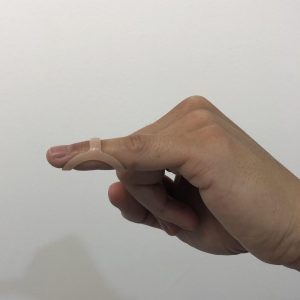
  • Slim in design and material
  • Keeps most of the finger exposed
  • Doesn’t require additional taping

Cons:

  • Expensive ($20)
  • Fitting for size before buying

Aluminium splint with foam padding:

Aluminium and foam finger splint for mallet finger
Source: Astir

Pros:

  • Readily available
  • Cheap ($10)

Cons:

  • Bulky
  • Foam may deteriorate with use and hand washing
  • Requires additional taping

Stax Splint:

Stax finger splint for mallet finger
Source: Astir

Pros:

  • Cheap
  • Durable

Cons:

  • Bulky
  • Pad of finger not exposed
  • Require additional taping

Tendon injuries usually require 6-8weeks to heal. It is extremely important to keep splint on 22-24hrs a day for at least 4-6weeks to avoid a “Swan Neck” deformity. The DIP should never be flexed, not even when the splint is off for cleaning or while adjusting the splint.

Mobility for rehabilitation can start after the initial splinting phase. However, splinting overnight is still recommended for a further 2-4 weeks there after.

How will your Physiotherapist and Osteopath treat mallet finger?

Your osteopath or physio will provide a combination of mobility, stretching and strengthening exercises for your hands, wrist and forearm to assist in gaining full function once the tendon has healed from the splinting phase.

One helpful exercise you can do after splinting is as follows:

  1. Use the opposite, unaffected hand to hold onto either side of affected finger. Keeping the middle finger joint straight.
  2. Actively flex the DIP (to a count of 5 and extend back to a count of 5)
  3. Repeat daily for 5 minutes a day.

After long periods of splinting, the DIP will be very stiff and you will notice once the finger is in the flexed position, full extension (straightening) of the DIP will be difficult. But with more practice and repetition, terminal extension at the DIP can be regained fully once again.
Tags
#malletfinger #mallet #finger #injury #handpain #fingerpain #sportsinjury #basketball #baseball #chiropractor #osteopathsydneycbd #osteopathsydneycity #osteopathcircularquay #osteopathwynyard #osteopathnearme #osteosydney #osteosydneyCBD # osteoydneycity #osteocircularquay #osteowynyard #osteonearme #chiropractor #physiotherapist #remedialmassage

Abigail Jones

Senior Physiotherapist

Abi discovered her passion for physiotherapy after supporting her mum through ACL rehabilitation following a ski accident, and later experiencing the power of quality rehab herself as a competitive swimmer managing a rotator cuff tendinopathy. These experiences inspired her to pursue a career focused on helping people move better and recover with confidence. She began her career as a rotational physiotherapist in the NHS in England, gaining broad experience across multiple specialties before transitioning into private practice with a strong interest in active rehabilitation and long-term functional outcomes.

Her treatment style is hands-on, exercise-focused, and evidence-based. Abi combines manual therapy with progressive, structured rehabilitation programs to achieve meaningful and sustainable results.

Abi uses a range of techniques including joint mobilisations, PNF techniques, dry needling, soft tissue therapy, taping, gym-based rehabilitation, and VALD ForceDecks testing for objective progress tracking.

Outside the clinic, you’ll find Abi sea swimming, running, at the gym, playing tennis, or creating content around rehab and active living.

Clinical interests include:

  • Running and sport-related injuries
  • Chronic low back pain
  • Shoulder rehabilitation, particularly rotator cuff tendinopathies
  • Progressive, structured rehabilitation programs

Languages spoken other than English: Conversational French

Abi is available at Quay Health. Call 1300 782 943 to make an appointment or book online.

Nerissa D'Mello​​

Clinical Lead Physiotherapist
Nerissa’s interest in physiotherapy began after experiencing multiple injuries growing up. Being in and out of clinics sparked her curiosity about how the body heals and inspired her to help others return to what they love. Early hands-on experience with a Scottish rugby club during her masters strengthened her passion for musculoskeletal and orthopaedic rehabilitation.
 
Now the Clinical Lead Physiotherapist at Quay Health, she has a strong interest in helping patients recover without surgical intervention when possible. Her treatment style combines hands-on techniques with exercise prescription, grounded in the latest research to promote lasting recovery.
 
Some of the techniques Nerissa uses are dry needling, VALD ForceDecks and Dynamo for data-driven rehab, taping, and shockwave therapy for stubborn tendon injuries.
 
She enjoys treating a broad range of patients, regardless of age, fitness, or background, and is currently expanding her expertise in women’s health.
 
Patients can expect a thorough, personalised approach focused on understanding their goals, hands-on treatment, and education in a supportive environment.
 
Outside work, you can find Nerissa training for her first full marathon, playing tennis, smiling at your dog, and trying to keep up with all her downloaded podcasts.
 
Clinical interests include:
 
  • Shoulder injuries, including rotator cuff and instability
  • Ankle sprains
  • Tennis and racquet sports injuries
  • Neck and upper back pain
  • Rehab from postoperative hip and knee replacements
  • Women’s health 
 
Languages spoken other than English: Conversational Hindi
 
Nerissa is available at Quay Health. Call 1300 782 943 to make an appointment or book online.

Jamie Belesky

Senior Physiotherapist

Jamie discovered his passion for physiotherapy through his own rehabilitation journey after tearing his ACL as a teenager playing football. Going through that process sparked his appreciation for how effective rehab can restore confidence and performance. He now has over 10 years’ experience working across musculoskeletal and sports physiotherapy in clinics in Wellington, Auckland, and London, including high-performance gym and sporting environments.

His treatment style is evidence-based, hands-on, and exercise-focused. Jamie combines manual therapy with structured rehabilitation programs to achieve long-term results and believes treatment should always be individualised to the person and their goals.

Jamie uses a range of techniques including dry needling, joint mobilisation, sports massage, taping, shockwave therapy, and VALD ForceDecks testing.

Outside the clinic, you’ll find Jamie running, surfing, playing golf, or watching football.

Clinical interests include:

  • Knee and ankle rehabilitation
  • Low back pain
  • Running-related injuries
  • Shoulder pain and instability
  • Tendon injuries

Jamie is available at Quay Health. Call 1300 782 943 to make an appointment or book online.