Becoming a parent comes with a lot of questions.
Why does my baby only turn their head one way? Why are they so unsettled after feeds? Is it normal for my baby to hate the car seat?
As osteopaths, we commonly work with babies, children, and new mums to help support comfort, movement, and overall wellbeing during periods of rapid growth and change.
What Is Paediatric Osteopathy?
Much like osteopathy for adults, a consultation for your little one involves a case history, assessment and treatment of babies, infants, children, and adolescents using gentle hands-on techniques tailored to their age, size and stage of development.
Children are not simply “small adults.” Their bodies are constantly growing and adapting, which means their musculoskeletal needs can be quite different from those of adults.
Why Might a Baby See an Osteopath?
The first few years of life involve rapid growth and development. During this period, babies learn to lift their heads, roll, sit, crawl and eventually walk.
Development doesn’t stop there. Your children will develop their balance, coordination, strength and movement patterns through to adolescence.
Tension, discomfort, or movement restrictions can sometimes make these milestones more challenging to reach or leave your child less comfortable than they could be.
An osteopath will assess how the body is moving, looking at muscles, joints, connective tissue and posture to help identify areas that may be contributing to discomfort.
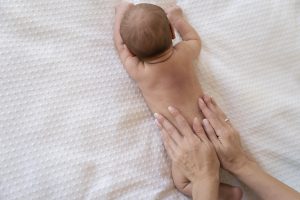
Common Reasons Parents Bring Their Baby
Every baby is different, we know this. There can be many variations in movement and behaviour that are completely normal.
However, parents may seek an osteopathic assessment if they notice their baby:
- Prefers looking or feeding to one side. This may be noticeable when sleeping, during tummy time or while breastfeeding.
- Has difficulty turning their head equally in both directions.
- Experiences discomfort during tummy time.
- Seems unsettled or has trouble settling.
- Experiences digestive upset, such as reflux symptoms or changes to bowel or bladder habits.
- Has flat spots developing on their head.
- Has experienced a difficult birth, including a long or very quick delivery or assisted delivery using forceps or vacuum.
- Would benefit from a general assessment of movement and comfort.
While an osteopathic assessment does not diagnose developmental disorders, it can help identify musculoskeletal factors that may be contributing to reduced movement or discomfort.
This will help us determine whether osteopathic treatment may be appropriate or whether a referral to another healthcare professional is recommended.
Osteopathy for Toddlers, Children and Teenagers
As children become more active, the physical demands on their bodies change dramatically.
While children often recover remarkably well, discomfort can sometimes alter the way they move during activities. Osteopathic treatment aims to help restore a comfortable movement pattern to return them to normal daily activities.
Older children more commonly present with:
- Growing-related aches and pains.
- Postural discomfort.
- Headaches associated with muscle tension.
- Sporting injuries.
- Neck and back pain.
- Persistent nocturnal enuresis (bedwetting).
- Recovery following injury.
Every child will present differently, and where concerns extend beyond the musculoskeletal system, osteopaths work collaboratively with GPs and other healthcare professionals to ensure appropriate assessment and management.
What Does the Research Say?
Much like all aspects of healthcare, the research into paediatric osteopathy is continuing to grow.
Here at Quay Health, your osteopath is focused on assessing and treating musculoskeletal factors that may be contributing to the discomfort or restricted movement of your child, working collaboratively with your GP, paediatrician or lactation consultant whenever appropriate.
References
Carreiro, J. E. (2009). An osteopathic approach to children (2nd ed.). Elsevier Health Sciences.
Schwerla, F., Daake, B., Moeckel, E., & Resch, K. L. (2021). Osteopathic Treatment of Infants in Their First Year of Life: A Prospective Multicenter Observational Study (OSTINF Study). Complementary Medicine Research, 28(5), 395–406. https://doi.org/10.1159/000514413